


Three free pages that read the filings nobody reads
On 31 July, Berkshire Hathaway sold 182,980 shares of DaVita, about $36.5 million of stock. The trade was reported to the United States government within days and has been free for anyone to read ever since. Almost nobody did.
That is the whole problem in one sentence. The information is public, it is free, and it is written for machines. So we built something that reads it every morning and writes down what happened in plain English.

The filing feed, including the DaVita sale. Every row links to the filing it came from.
Why this is harder than it sounds
Indian readers are used to the NSE and BSE publishing bulk and block deals daily. The United States has no equivalent. What exists instead is a tiered system: quarterly holdings reports, stake filings when somebody crosses five percent, and insider transaction forms within two business days.
All of it is public and free. None of it is convenient. The advantage goes to whoever actually reads it, which is a smaller number of people than you would expect.
What we built
The Smart Investor Tracker is three pages, and all three are free. They read filings published by the Securities and Exchange Commission every morning and set out what thirty super investors and the insiders of S&P 500 companies actually did. No estimates and no third party feeds. Every line links to the document it came from.

The Smart Investor Tracker, by The Microcap Minute Global.
Page one: the filing feed
What arrived, read every morning, written out in ordinary English, keeping the last thirty one days. Buys, sells, new stakes and insider transactions, each one with the date it was filed and a link to the filing itself.
The thirty, and why those thirty
They were chosen by hand and not by fund size. Buffett, Klarman, Li Lu, Pabrai, Ackman, Hohn, Terry Smith and twenty three others.
The rule was concentration. A fund holding two hundred companies has told you almost nothing by adding one more. A fund holding ten has made a decision, and every filing it makes is worth reading. The full reasoning, and the four things we asked of each investor, is published here:
Page two: portfolios
What all thirty own, from their most recent quarterly reports. $528 billion of holdings, with new positions, additions, trims and exits marked against the quarter before, sortable however you like, and every investor linked to the exact filing the figures came from.

Thirty investors, 528 billion dollars of holdings, everyone at a glance.
One investor up close. Berkshire’s twenty nine positions: what each is worth, what share of the money it carries, and what changed since last quarter. Twenty two percent of it sits in a single stock. Four positions were sold to nothing.
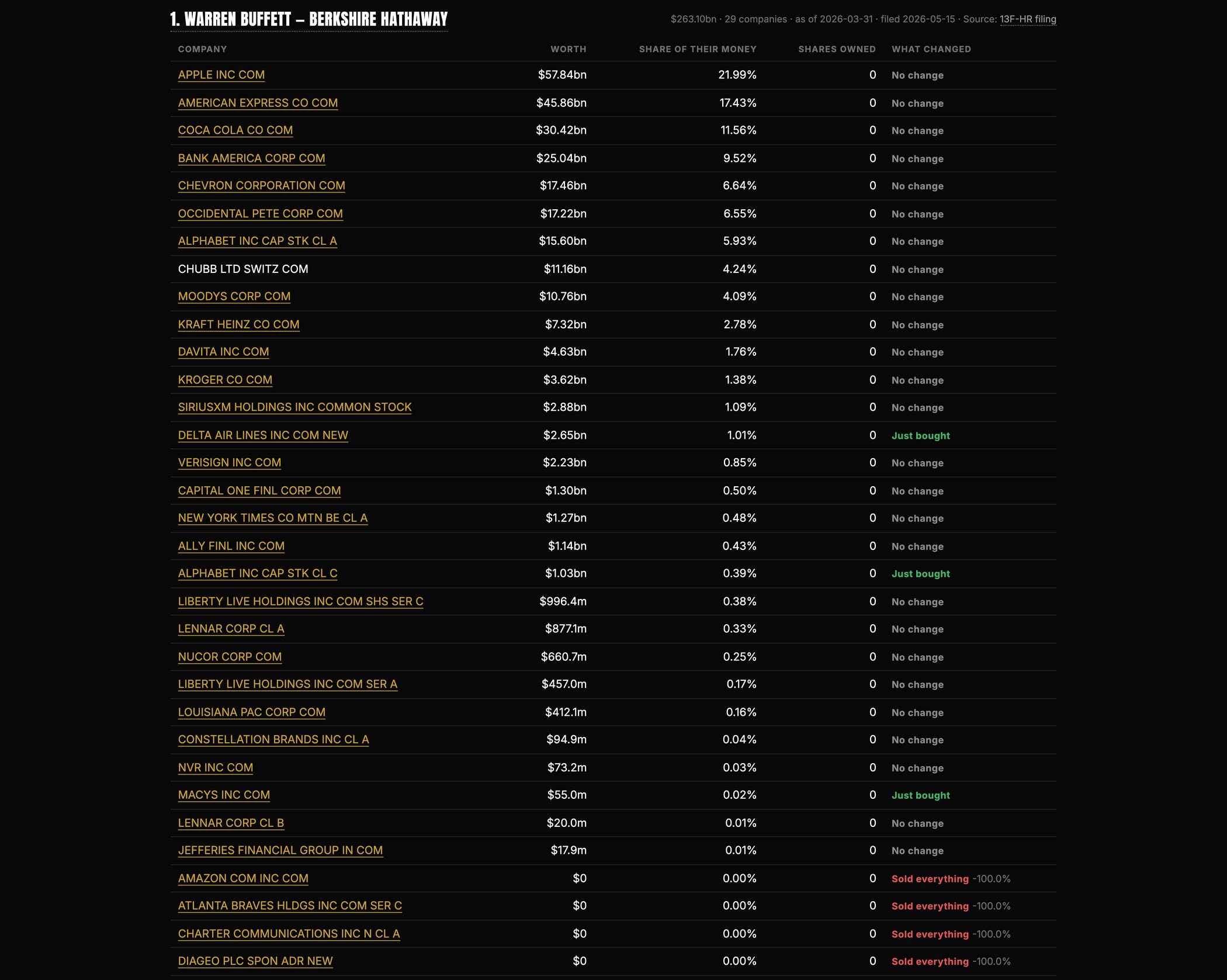
Berkshire Hathaway’s twenty nine positions, and what changed in each.
Page three: promoter buying
Insiders of S&P 500 companies buying their own stock with their own money. Only open market purchases count here, which is the point: option exercises, grants and gifts are excluded, because none of those is somebody deciding to spend their own cash. One slider widens the window from a week to a month.
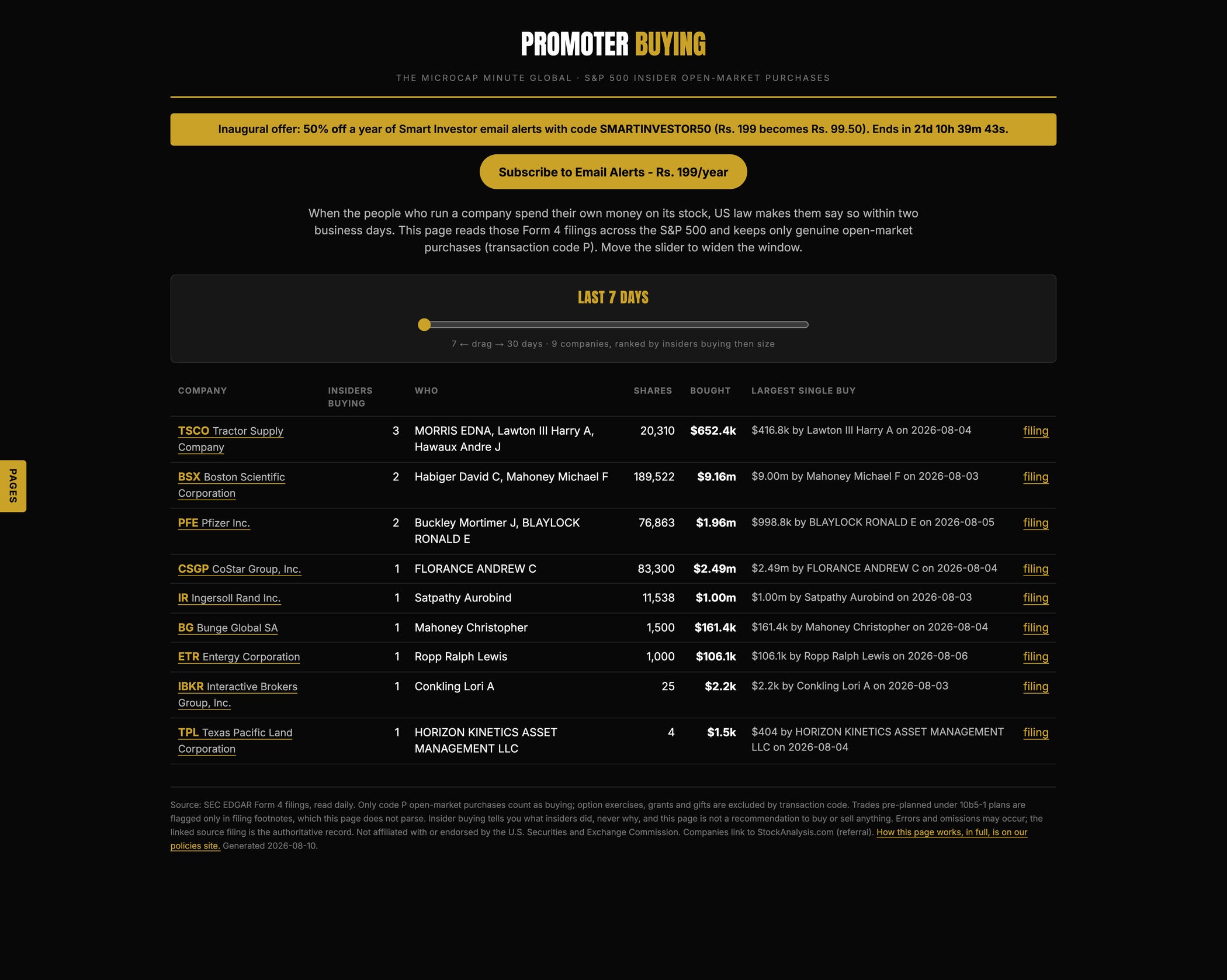
Promoter buying, with the seven to thirty day slider.
Free, and please check our work
All three pages are free and will stay free. The data is public and we simply read it. Errors and omissions are possible, which is exactly why every row links to the filing it came from. If a number looks wrong, open the filing and tell us. That is not a disclaimer, it is the point.
If you would rather have it delivered
One email every Monday with the week’s super investor filings and promoter buying, for Rs. 199 for a full year, paid once, with no automatic renewal. This is the cost it would take me to send you roughly 52 mails at scale.
Still, as a launch offer, the code SMARTINVESTOR50 takes fifty percent off until 31 August.
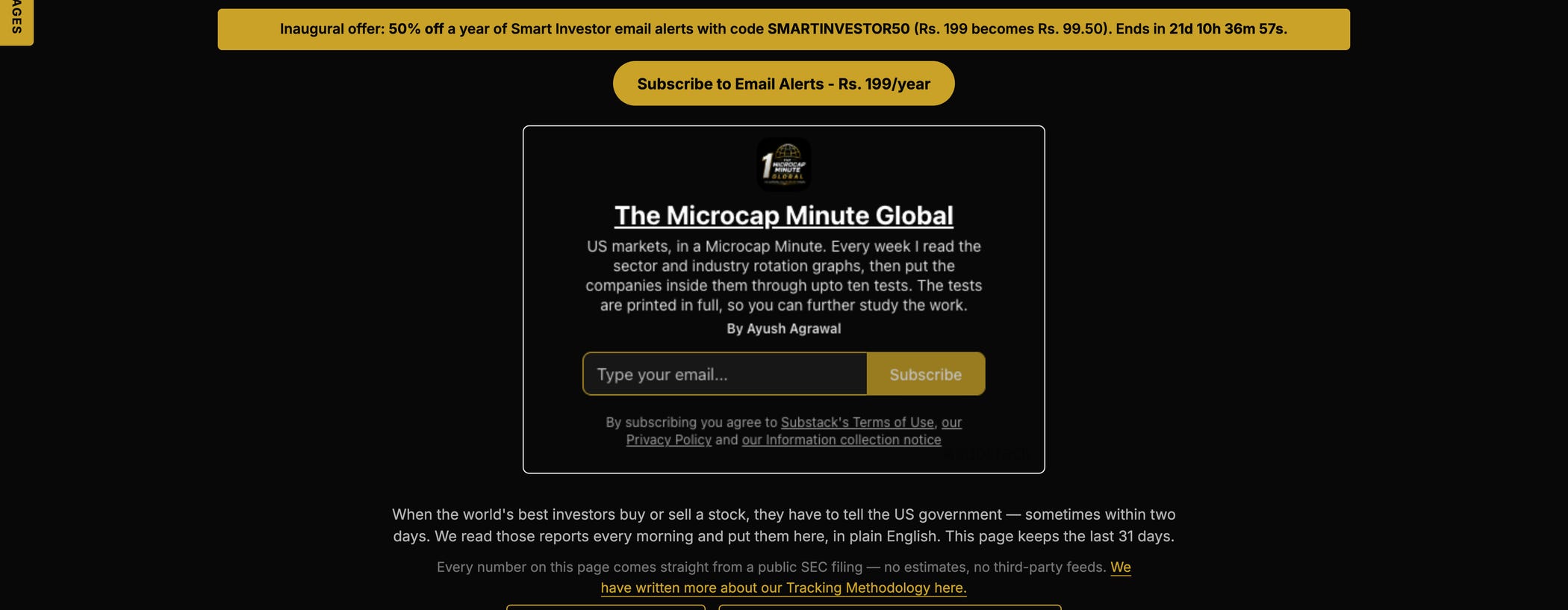
The launch offer: fifty percent off a year, with code SMARTINVESTOR50.
From The Microcap Minute Global. This is impersonal commentary of general and regular circulation. It is not investment advice, it is not a recommendation to buy or sell any security, and it is not tailored to any person and most of all it is not a solicitation of any kind. Tracking an investor is not endorsing them, and none of the thirty has any connection to this publication or its author.